
We4 Clinical Research Prepares for the Gender Equality Certification: Our Commitment to an Equitable and Inclusive Work Environment
In recent years, the issue of gender equality has taken on central importance. Companies are actively working to ensure equal opportunities, pay equity, and inclusive environments where every employee can fully realize their potential. At We4 Clinical Research, we firmly believe that valuing diversity is essential for driving innovation, productivity, and sustainable growth. Verso la…

When Tech meets Empathy: Designing tools that truly works for people
“The great myth of our times is that technology is communication.” – Libby Larsen We often celebrate technological progress as if it were an end in itself. But in clinical research, tech that doesn’t connect with people quickly shows its limits.True innovation happens when technology and empathy work together, enabling research teams not just to…
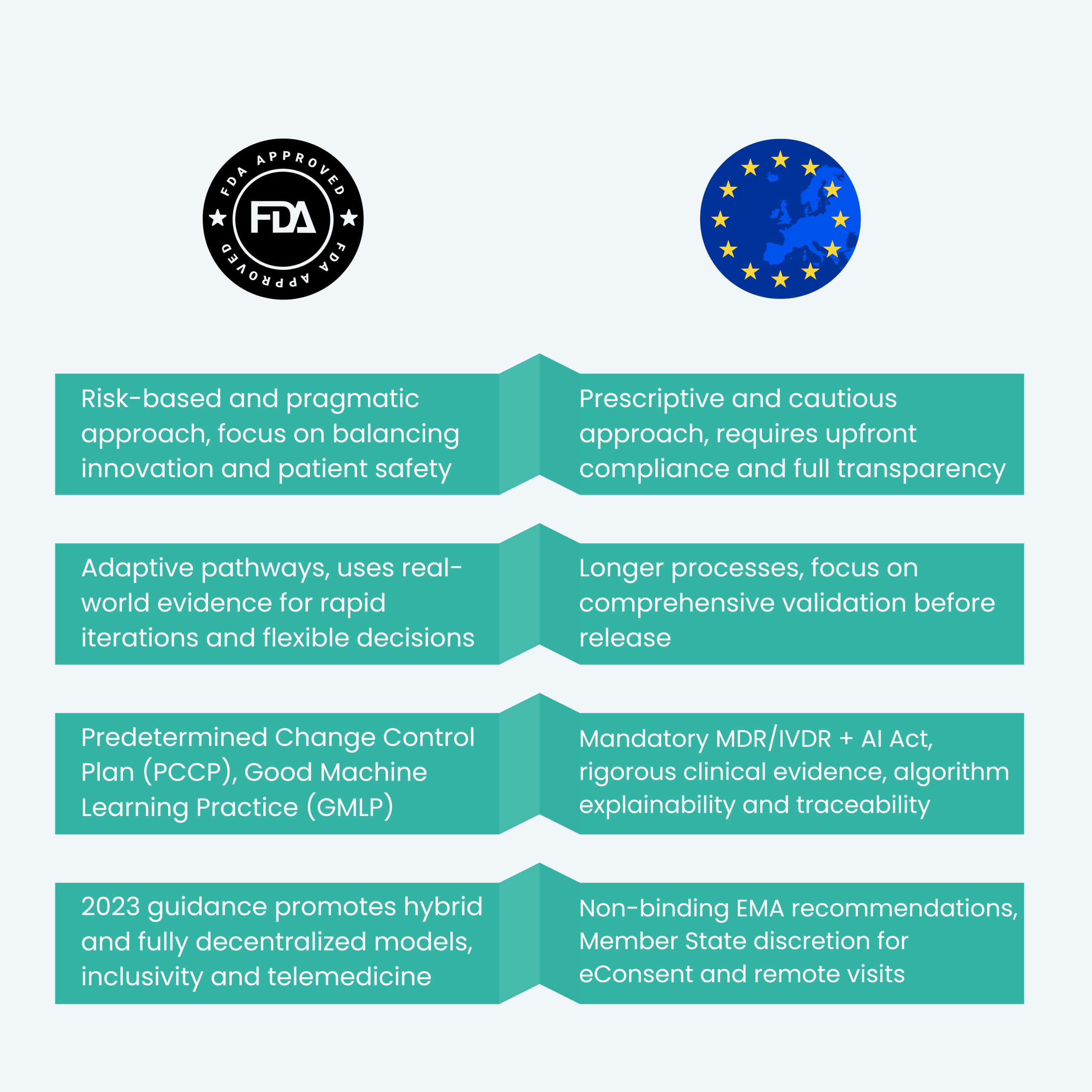
FDA vs EU: how to keep up with confusing regulations
Future is now. What we used to imagine as something for the year 3000 is already here, woven into our everyday life. Technology has reshaped our habits so profoundly that it’s hard to remember how things worked before. In clinical research, this transformation has been nothing short of pivotal. From Artificial Intelligence (AI) to Software…

The Expert Take | When RCTs aren’t the best choice: finding the right study design for Medical Devices
“RCTs are the gold standard.” That’s the mantra we all know in clinical research, and it’s true. Or rather, almost true. Because when it comes to medical devices, that model starts to crack.Devices live in a reality that’s dynamic, operator-dependent, and constantly evolving.Recognizing when an RCT isn’t the right choice doesn’t mean lowering the bar: it means…

Beyond automation: when technology takes shape around people
There’s a moment at the start of every clinical project when everything begins to take shape.A protocol comes to life, timelines become real, and a team starts building trust. That’s the moment technology enters the picture: not to dictate the rules, but to listen. Because no matter how advanced a platform is, technology only makes…

Ready for the next draft: what will change in the regulation of AI medical devices by 2026
There’s a silent revolution underway in the way we regulate Artificial Intelligence in medicine. For years, the conversation has been all about validation: collecting data, measuring performance, defining protocols, proving that the model works.The logic was linear: if it works, it can be certified. But 2026 marks a turning point.It will no longer be enough…

How Risk-Based thinking drives digital trials
In recent years, clinical research has embraced a new vocabulary: decentralized, remote, hybrid, digitalized, connected. Terms that once belonged to the future now define our daily operations. With hybrid models (combining onsite visits with remote data collection) and the growing adoption of connected devices, ePRO platforms, study portals, and workflow management systems, clinical trials have…

The most common mistakes in digital trials (and how to avoid them)
There’s one thing no one admits openly, but anyone working in digital trials has learned the hard way: technology is brilliant when everything is under control, and ruthless the moment something slips. In digital environments (wearables, ePRO, platforms, real-time data), weak signals don’t exist. Every error grows. Every ambiguity multiplies. Every uncertainty becomes impossible to hide.…

Patients are evolving faster than trials: why clinical data are falling behind
In clinical research, we speak often about patient-centricity. Yet in the past two years something unexpected has happened: patients’ real lives have become more digital, more monitored, and more interconnected than the trials designed to study them. The patient has changed.Their data pathways have not. Not because the industry lacks intent, but because traditional study…

Post-Market 2.0: how continuous Real-World Evidence is redefining medical devices
There’s a silent but radical shift reshaping the value of medical devices, more than any new technology or algorithm. A shift born in real life: in patients’ routines, phones, homes, and clinical journeys. Its name is Real-World Evidence (RWE).And it is turning post-market from a formal requirement into a strategic engine of safety, performance, competitiveness,…